

They Fired the Team to Save Money. Now the AI Bill Is Higher Than the Salaries Were.
The math was supposed to work. It isn't.


New here? I write about what’s actually happening in AI from someone building it in Lagos, honestly. Subscribe below.
Opinion piece. All stats verified against Business Insider, Forrester, The Information, Fast Company, Reuters and Axios. Sources at the bottom.
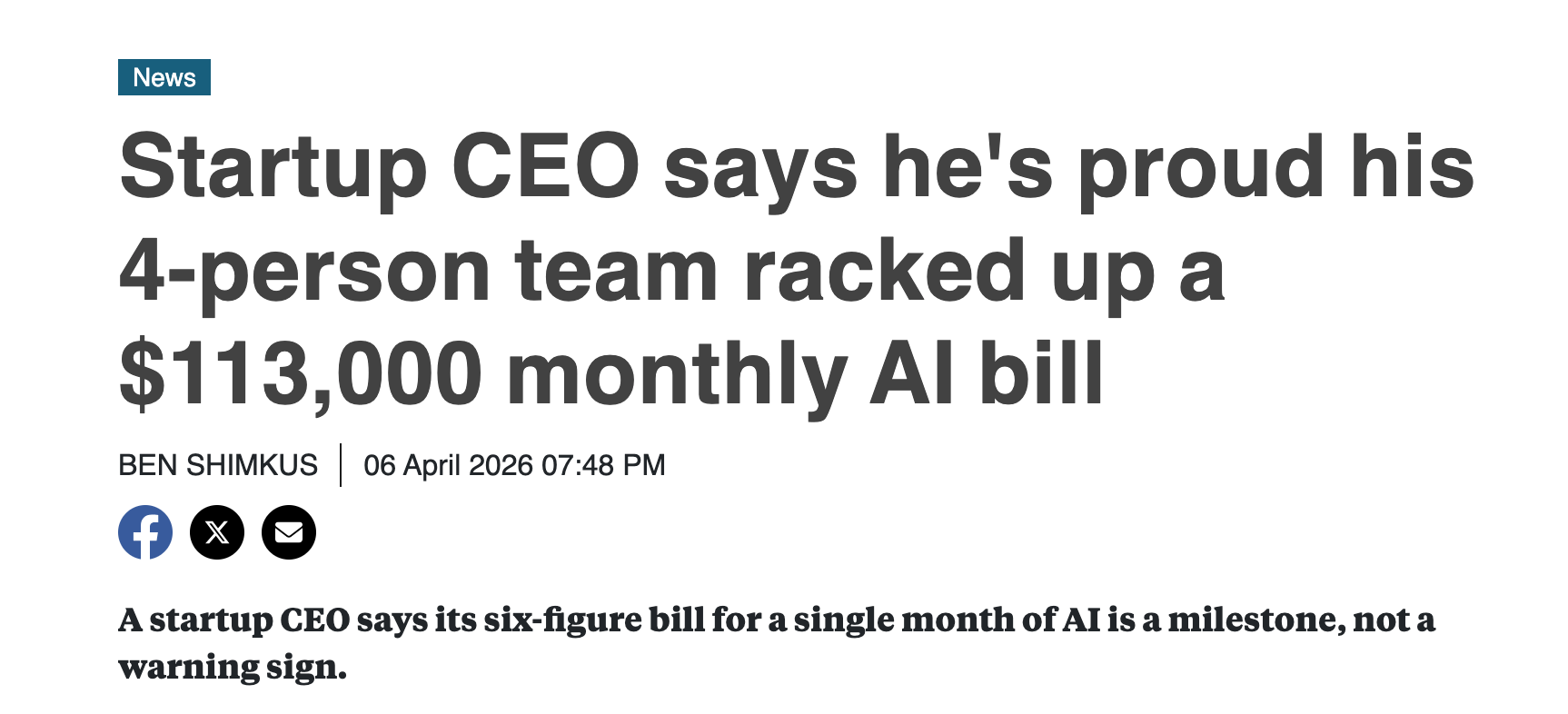
A startup called Swan AI has four people on the team.
Last month their Anthropic bill was $113,000.
In one month. Four people. $113,000.
That’s more than most engineering teams cost for a year. And they’re a four-person startup. They posted the invoice publicly proudly, actually as a flex about how hard they’re pushing AI.
I stared at that number for a while.
Then there’s Uber. $3.4 billion R&D budget. One of the most well-resourced tech companies on earth. They burned through their entire 2026 AI budget in a few months because engineers couldn’t stop using Claude.
Not the company using Claude at scale on products. The engineers. Using it in their day-to-day work. The bill just kept climbing.
These aren’t edge cases. These are the early signals of something the industry doesn’t want to say out loud yet.
The AI cost savings everyone promised? For a lot of companies, they’re not showing up. The token bills are.
Here’s what nobody put in the press release
When companies started laying people off to “go all in on AI” last year, the pitch was simple. AI is cheaper. AI doesn’t take sick days. AI scales infinitely. Replace the headcount, keep the output, save the money , blah blah blah..
The math looked clean on a slide deck.
What the slide deck didn’t include:
AI inference the actual cost of running these models at scale now eats between 55 and 80 percent of most companies’ AI budgets. Token usage for heavy users has jumped 50x in the last year. AWS and Google have raised inference prices by 15 to 100 percent in recent months. One AI agent running complex tasks costs roughly $100,000 a year to operate. That’s a mid-level engineer’s salary except the agent still needs a human supervising it, checking its work, and catching the 42 to 65 percent of complex tasks it gets wrong.
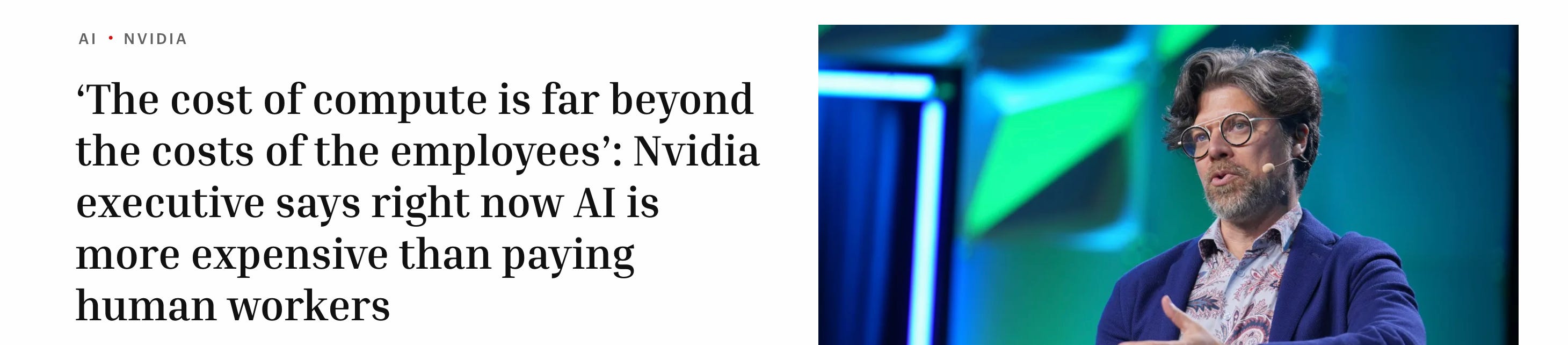
Nvidia’s VP of Applied Deep Learning said it plainly a few weeks ago: “For my team, the cost of compute is far beyond the costs of the employees.”
That’s not a critic saying that. That’s someone inside one of the companies that profits most from AI adoption.
The 55 percent nobody’s talking about
Forrester ran a survey. 55 percent of companies that did AI-driven layoffs now regret it.
55 percent.
74 percent of them reported that output quality dropped noticeably after the cuts. Customer support escalations went up. Institutional knowledge walked out the door with the people who had it. The AI agents that were supposed to fill the gap are succeeding on complex multi-step tasks only 35 to 58 percent of the time.
Klarna laid off hundreds of support staff to replace them with AI chatbots. They’re quietly rehiring now. IBM did something similar. The chatbots handled the simple stuff fine. The moment a customer had a real problem something nuanced, something emotional, something that required actual judgment the bots fell apart.
The humans who used to handle those conversations had years of context. The model had a system prompt.
If any of this is landing different from what you've been reading everywhere else, share it with one person who needs the honest version.
The part that bothers me personally
I build AI tools for a living. I’ve written about this series of events since February. I believe AI is genuinely the most important shift happening in the world right now.
And I still think what’s happening to a lot of workers is being sold dishonestly.
The narrative is: AI replaces the boring parts of your job and frees you for higher-value work. That’s true in some contexts. In a lot of others, what’s actually happening is: company fires the team, discovers the AI bill is higher than expected, discovers the quality isn’t what was promised, and is now stuck between admitting they moved too fast or doubling down.
The workers who got let go don’t get to wait for that reckoning. They needed next month’s rent before the quarterly review came back with bad numbers.
That’s the gap in the conversation nobody wants to sit in. The companies get time to adjust. The people don’t.
What this actually means going forward
The companies that are going to win this transition aren’t the ones that replaced the most humans the fastest.
They’re the ones that figured out where AI genuinely outperforms and where humans still have an edge and built systems that use both honestly.
The “talent over tokens” conversation is just starting. Companies are beginning to realise that a team of people who know how to work WITH AI might be cheaper, faster, and more reliable than a fully automated stack with a huge inference bill and a quality problem.
The boomerang is coming. Klarna and IBM are the first signs. They won’t be the last.
What it means for you specifically
If you’re an employee right now: the loyalty test questions I wrote about last week “do you have bandwidth, would you relocate, are you open to leading this” — those questions are happening inside companies that are also quietly watching their AI bills climb. The ones who figure out how to lead the human-AI hybrid are going to be more valuable in 18 months than the pure-AI bet looked six months ago.
If you’re a founder: the enterprise mid-pivot window I wrote about is real, but the pitch has changed. It’s not “let us automate everything.” It’s “let us show you what should be automated and what shouldn’t, and build you the thing that actually works.” That’s a harder sell and a more honest one. It’ll compound.
If you’re watching this from Nigeria, Ghana, Kenya, UK , United States, or anywhere else that got hit first by the initial job displacement wave: the rehiring wave that’s coming won’t be coming to us first. The entry-level remote jobs that got automated away aren’t coming back in the same form. The answer is still building something of your own. I don’t have a more comfortable version of that.

The real headline
Companies fired people to save money on salaries.
The AI bill is now higher than the salaries were.
55 percent of them regret it.
The workers they let go are still figuring out rent.
That’s the full picture. The slide deck version leaves out the last two lines.
What’s your honest read on this — are we watching a bubble correct itself, or is this just the messy middle of a real transition?
Drop it in the comments. I read every reply.
— Alex, MBM
If this piece gave you something the usual AI coverage doesn’t — subscribe below. Every Monday, from someone actually building in this. No ads. No fluff.
Sources:
Swan AI $113k bill — Business Insider, April 6 2026 + Amos Bar-Joseph LinkedIn post
Uber AI budget — The Information, April 14-16 2026
55% regret stat — Forrester 2026 Future of Work Predictions
Klarna/IBM rehiring — Fast Company, WSJ, Reuters 2025-2026
35-58% task success — Salesforce CRMArena-Pro, Carnegie Mellon, Patronus AI
Bryan Catanzaro quote — Axios, Fortune, Yahoo Finance April 26-28 2026
If you missed my last article, no worries — read it here

This hit hard! I bet those companies who fired staff to lower their budgets are deeply regretting their actions!
Customers definitely prefer humans over AI especially if there's a serious issue, give me a human any day!!
Thanks for always giving the real headlines in a clear, engaging way! You're a pro!